Gooty Sapphire Ornamental
Poecilotheria metallicaa.k.a. “Gooty Sapphire”
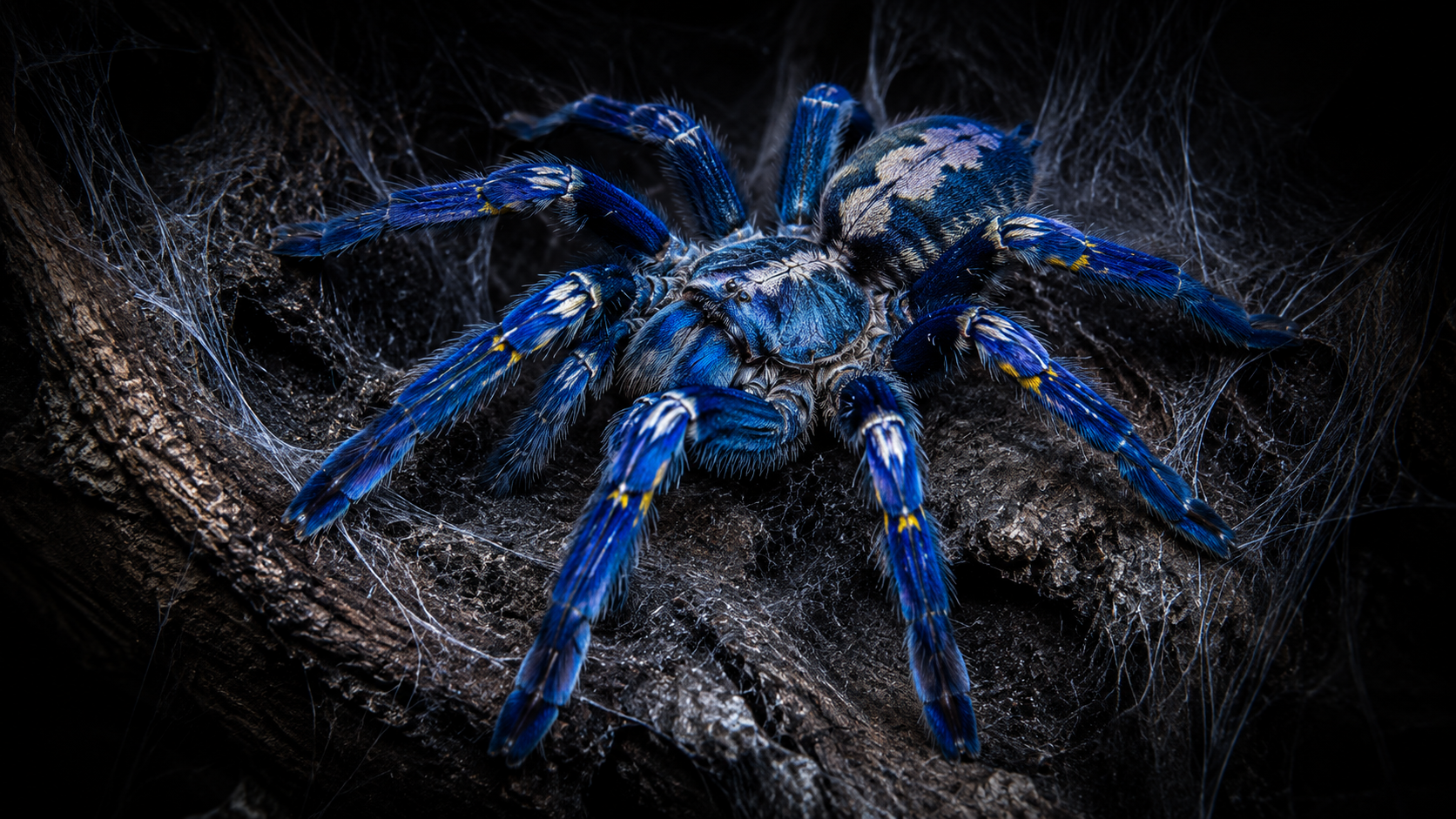
SPECIMEN LABEL
- FAMILY
- Theraphosidae
- RANGE
- Eastern Ghats of Andhra Pradesh, India, with published records extending farther south into Tamil Nadu
- HABITAT
- Dry deciduous forest, arboreal, usually in tree hollows, bark crevices, and silk retreats on mature trunks
- LEG SPAN
- Up to 7 in / 18 cm
- TEMPERAMENT
- Shy, lightning-fast, and happiest when ignored
- COLORATION
- Electric sapphire blue · Fractal white leg banding · Geometric patterned abdomen · Cream and yellow ventral warning patches
FIELD NOTES
There is no fair way to describe Poecilotheria metallica to someone who has not seen one. It is a large spider in vivid electric blue, wearing a geometric pattern that looks hand-painted. Evolution was not showing off for us, and somehow that makes it better.
Despite the crown-jewel reputation, it behaves like a proper Poecilotheria. This is a hollow-dwelling ghost, built for bark, height, and vanishing vertically before your brain catches up. You do not handle a pokie. You witness one.
Its home is not a rainforest fantasy. It is a dry deciduous forest spider tied to the Eastern Ghats, where mature trees, bark fissures, and trunk hollows matter more than humidity myths. The tree is not scenery. The tree is the whole address.
The species became famous partly because the color feels impossible. Blue on an animal this large does not read as camouflage until you see it against bark and lichen and realize nature knows exactly what it is doing.
It is also one of the hobby's most serious reminders that beauty and vulnerability often travel together. Poecilotheria metallica is listed as Critically Endangered, and habitat loss has always been part of the story.
The old line says it lived in one tiny patch near Gooty and nowhere else. The truth is a little more interesting. Later published records expanded the picture into other parts of the Eastern Ghats, but this is still a narrow-range species, not a spider with room to waste.
WHY IT'S IN THE COLLECTION
A living crown jewel: critically endangered, impossibly blue, and proof that nature's most unreal designs often belong to animals most people never notice.


